 Client Portal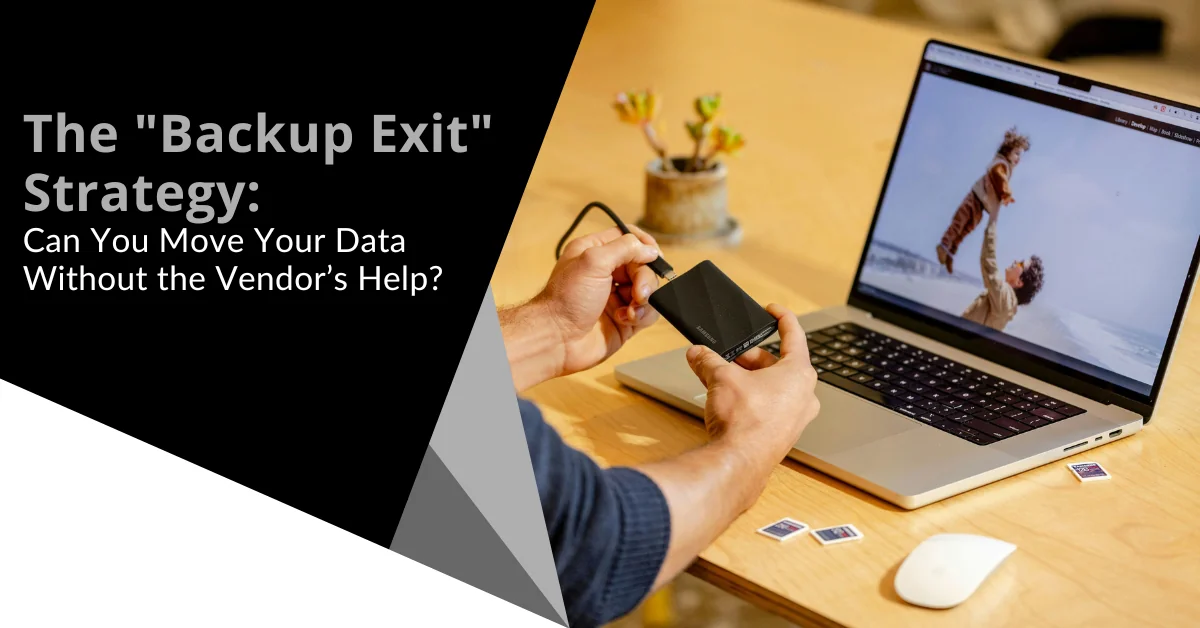
When you first sign up to a cloud platform, everything is built to feel easy. Onboarding is smooth, the support is attentive, and your data flows in without a hitch.
The first real test of that relationship is not the start. It is the exit. For a lot of small businesses, from a broking firm in Moorabbin to a transport operator in Dandenong South, the front door is wide open and the emergency exit is bolted shut. Exports come out incomplete, key data sits in a format only the vendor can read, and leaving means paying that same vendor to let you go.
What this actually looks like
Your business data rarely lives in one tidy place. It is spread across platforms, integrations, plug-ins and automations that have built up over years.
So when a vendor changes their pricing, their terms, their features or their security posture, you are not "switching tools" with a click. You either move your data cleanly, or you stay where you are because moving feels too hard.
That is vendor lock-in in practice. It is not a dramatic event. It is the quiet realisation that your options have narrowed without you noticing.
Why it matters
A weak exit plan does more than slow you down. It costs you money, and it raises your risk.
On the cost side, spending becomes sticky. You cannot right-size quickly, retire duplicate tools, or move a workload to a better-fit platform without turning it into a major project. Every renewal and price rise becomes a forced decision instead of a considered one. The real cost is not the monthly invoice. It is the loss of choice.
On the risk side, exits and migrations often happen under pressure, and pressure is exactly when mistakes happen. Verizon's 2025 Data Breach Investigations Report analysed 12,195 confirmed breaches across 139 countries, the highest number it has ever recorded in a single report. IBM's 2025 Cost of a Data Breach Report puts the global average cost of a breach at USD 4.4 million.
Attackers have also turned their attention to credentials and data pathways, the very things you lean on during an export or migration. Microsoft's 2025 Digital Defense Report notes attempts to extract sensitive data from storage accounts and databases rose 58 per cent, and that data theft featured in 80 per cent of the incidents its team responded to.
If you cannot export your data safely and on your own timeline, you are stuck. You cannot move away from a risky platform quickly, and when you do move, you risk creating new exposure.
What actually works
A backup exit strategy is about being able to leave on your terms, before you ever need to. Here is where to start.
First, check portability up front. Before you commit to a platform, confirm you can export a complete copy of your data, in a usable format, on your own schedule, without surprise "egress" or extraction fees. Get the answer in writing.
Second, treat any migration as a high-risk event. When data moves, your team is often signed into several admin-level tools at once, with a lot of data in motion. That is precisely what an attacker wants. Use phishing-resistant sign-ins for migration and admin accounts, and run the work from managed, patched, protected devices.
Third, tighten your session controls. An attacker does not need to crack a password if they can steal the session token that proves you are already signed in. Microsoft has documented adversary-in-the-middle phishing that intercepts session cookies to reuse an authenticated session and skip the MFA prompt. Make privileged sessions expire sooner, and require re-authentication for risky actions.
Fourth, keep watching while the move happens. Monitor for unusual access during the migration window, not just before and after it.
A good exit plan is not about planning to leave. It is about never being trapped if you choose to.
Where Agile IT fits
This is core to how we run AgileMANAGED. We design backup and business continuity so your data stays portable, recoverable and yours, on our CORE and Complete tiers, rather than locked inside one provider's format.
It also sits squarely within AgileSECURE, where data protection and ransomware resilience mean securing the move itself: phishing-resistant access, healthy devices and tight session controls during the moments your data is most exposed. We supply and manage Microsoft 365 as part of this, with the same focus on keeping your data exportable and under your control.
The businesses that do well over the next few years will not just adopt new tools. They will stay flexible as tools change, because their data is clean, their processes are clear, and they can move when it makes sense to.
If you would like a hand building an exit-ready baseline across your vendor stack, that is a conversation worth having. We will help you map where your data lives and how easily you could move it.