 Client Portal
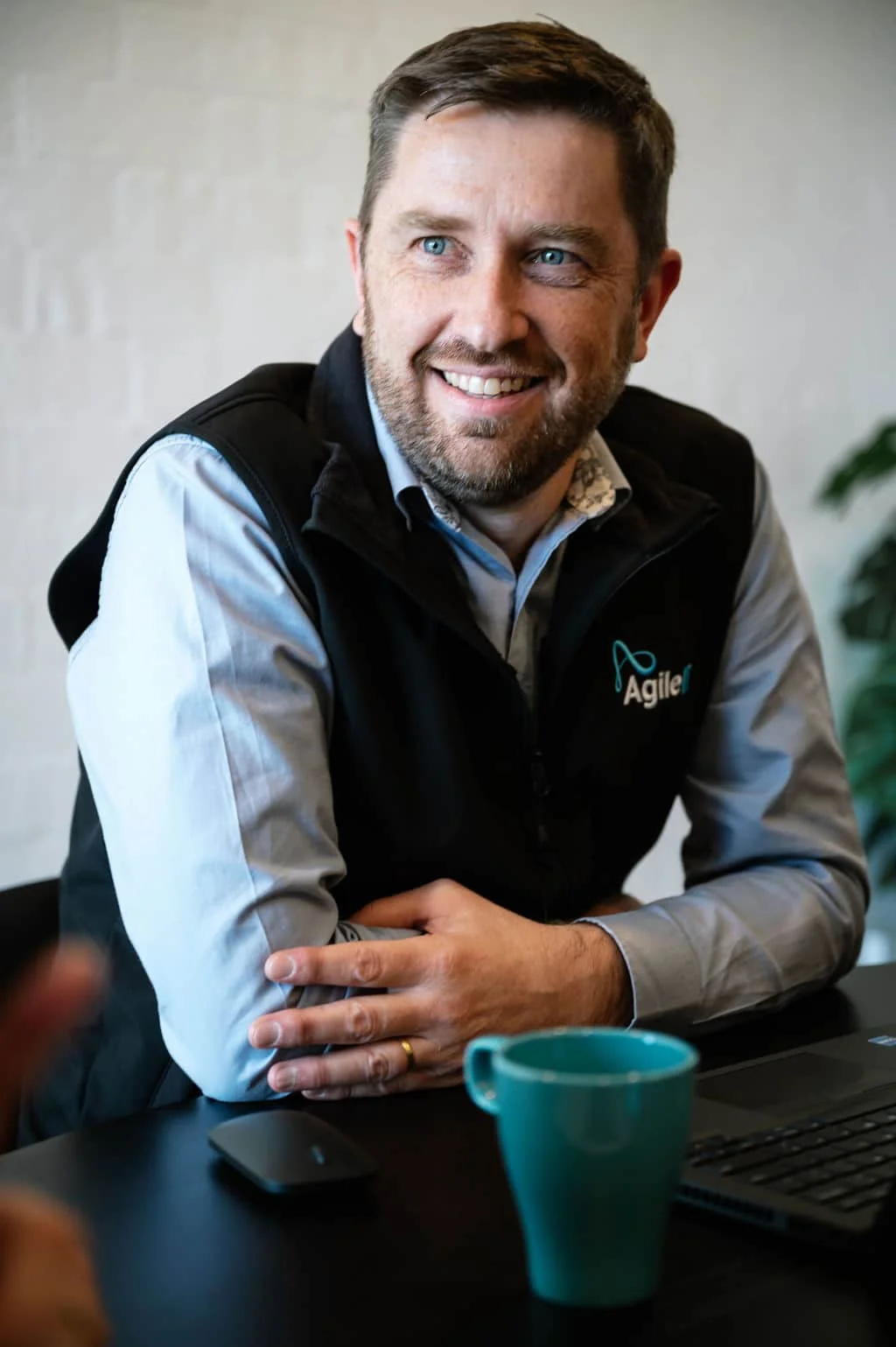
Author
Managing Director, Agile IT Solutions. Helping Australian SMBs run technology deliberately since 2007.
I want to start by saying this is not really a post about IT. It is about how a business makes decisions as it grows, and I have had a front-row seat to it for nearly twenty years, mostly with businesses of five to fifty staff across Melbourne and the Mornington Peninsula.
I started Agile IT in 2007, and in that time I have watched a lot of businesses move along the same path. It usually goes like this. You start by doing things yourself to save money. You call for help when you need it. You begin asking for advice before you act. You build a relationship with someone you trust. And eventually, you decide to run things properly, on purpose, instead of reacting to whatever lands on your desk that morning.
IT follows that same path, and most owners can place their business on it within about thirty seconds. I have made my own way through every one of these stages, so I am not pointing at anyone. The useful question is not which stage you are at. It is whether you move to the next one deliberately, or wait until something forces you.
IT works, right up until it becomes critical
In the early days, IT just needs to work. You get a few laptops going, set up email, plug in the internet, and get on with the actual business. There is nothing wrong with that. For a small, simple business it is exactly the right call, and I would tell you to do the same.
The catch is that the role IT plays changes as the business grows, and it changes quietly. The setup that was fine for three people becomes the thing that holds back fifteen. Most owners do not notice the shift until something breaks at the worst possible time.
Here is the progression I see, stage by stage.
Stage 1: Do it yourself and control the cost
Every business starts here, and I understand it completely, because I am exactly that person. Most small businesses have someone who can keep things running: a staff member, a family member, or the founder, with enough IT knowledge to set things up themselves and save some money.
The fixes are ad hoc. When something goes wrong, someone works it out, or it waits until the weekend. The focus is simple: keep costs down and keep things moving.
I am no different at home. When we renovated our bathroom, I looked at it and thought, yep, I can do that. And I could. But it took months. While I saved money, it was not my best work, and there have been things needing a second look ever since.
So did I save money? Yes. Did we end up with a working bathroom? Yes. Could I have spent those months on something more valuable if I had called a professional? Absolutely.
That is the real trade-off with doing it yourself, whether it is a bathroom or a business. It works because the business is still small enough to hold in one person's head. Nothing is written down because it does not need to be, and there is no standard because there is only one of everything.
At this stage, IT is a task, not a function of the business.
For a while, that is completely fine. The only question is what it is quietly costing you in time, in quality, and in the things you keep having to come back and fix.
Stage 2: Get help when things break
As the business grows, doing it yourself starts to strain. You bring in someone when things break. An IT person you call in a hurry, a friend of a friend, the person who set things up a couple of years ago.
It is still reactive, but the awareness is growing. You have started to feel the cost of things not working.
I know this pattern well, because I used to be the person people called. A problem appears, you scramble for help, it gets patched, and everyone moves on until the next one.
The business has started to feel the impact, but nothing underneath has changed.
Stage 3: Start seeking advice, not just fixes
This is where I see something shift, and it is my favourite stage to watch.
You stop only calling when things break and start asking better questions. Is this the right setup for where we are heading? Are we exposed anywhere? Should we be doing this differently?
Decisions start to involve outside input. There is still no real structure, and probably no plan, but the intent has changed. You are no longer just trying to make the problem go away. You are starting to ask whether the whole approach is right.
This is the point where IT stops being purely technical and starts becoming a business decision.
That shift in thinking matters more than any piece of technology, because it changes who is in the room and what questions get asked.
Stage 4: Build a trusted partnership
Eventually the relationship changes shape. Instead of calling for fixes, you have someone who knows your business and is involved before decisions are made, not after.
Advice, guidance and accountability start to sit in the relationship, not in individual problems.
This is the distinction I care about most, and it is the one I built Agile IT around.
A supplier fixes things. A trusted partner helps decide how things should work.
A supplier is reactive by design. You call, they respond, you pay, and it ends. A partner is different. They are at the table when you are planning, they raise risks you have not considered, and they share responsibility for the outcome. In practice they function as your outsourced IT department.
Stage 5: Take IT seriously and run it properly
The final stage is where IT is run deliberately.
There are defined standards, so every device, account and system is set up the same considered way. The environment is planned rather than inherited. Security is managed, not assumed. Accountability sits with someone specific, not whoever happens to be free. And IT is pointed at business outcomes, not just at keeping the lights on.
This is what I mean by doing things properly. And to be clear, I do not mean gold-plating, or buying the most expensive option, or spending for the sake of it.
Taking IT seriously is not about spending more. It is about deciding how it should work, and then running it that way consistently.
Consistency is the whole point. The businesses I admire most are not the ones with the biggest IT budgets. They are the ones that decided what good looks like and then held to it.
The cost of not making the shift
The hardest place to be, and the one I see most often, is stuck between stages. Usually between doing it yourself and running it properly.
The business has outgrown the old approach but has not committed to a new one. The result is a low, constant drag. The same issues come back. Small frustrations build. The team works around problems that should have been fixed once.
If you have ever lived with a renovation that is almost finished, you will know the feeling. The jobs that were never quite urgent enough are still on my bathroom list today, and probably will be next year. A business stuck between stages is the same. Nothing is broken enough to force the decision, so the decision never gets made.
The part that does the real damage is the risk you cannot see. When nobody owns the environment, nobody is watching it. Backups go untested. Access is never reviewed. A quiet gap sits there until the day it becomes a loud one.
None of this announces itself. It just waits.
I am not telling you this to worry you. Plenty of businesses run this way for years and get away with it. But getting away with it is not the same as running it well. The gap between the two is where the cost quietly hides.
The real question
Every business reaches the point where the old way of handling IT stops serving it. That is not a failure. It is just what growth does.
The question is not whether you will get there. It is whether you recognise it early, or get pushed there when something breaks that you cannot afford to get wrong.
Whether you are a growing trades business in Pakenham or the owner of an established practice, recognising it early is cheaper, calmer and entirely within your control. If you read this and quietly placed your business a stage or two behind where you would like it to be, I would be happy to talk it through. Not a sales pitch. Just a conversation about where you are and what moving forward would actually involve.
Linden Jackson
Agile IT Solutions