 Client Portal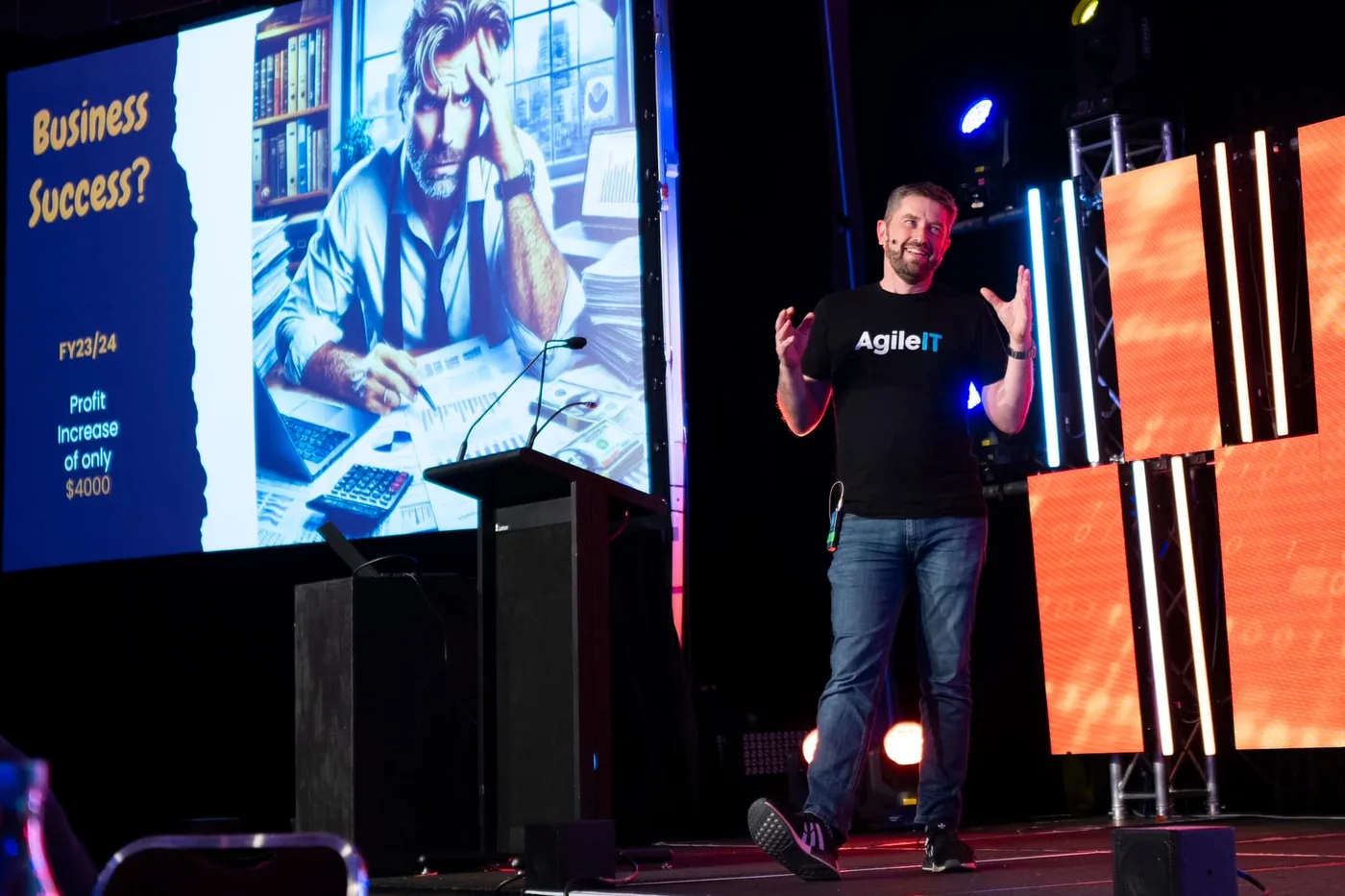

Author
Managing Director, Agile IT Solutions. Helping Australian SMBs run technology deliberately since 2007.
I was given a 20-minute spot to share something useful with the room at the SMBiT Professionals conference, October 2024. The theme that year was "Step Up: the year of the MSP evolution." A room full of people who run businesses like mine. Founders, owners, MDs. People doing the same job, with the same pressures.
I had a couple of slides about how the year had gone. One of them was very easy to put up. The other one I almost did not show.
The easy slide
Like everyone, I had spent the year hearing the same advice on repeat. Just raise your prices. It is easy. So that is what we did. We tightened up how we were quoting, lifted rates where they had not moved in years, and went into FY23/24 with a clearer line on what our work actually cost.
It worked, on the metric I was looking at. We finished the year with turnover up 36%. About $250,000 in extra revenue compared to the year before. By every external measure, it was the best year the business had ever had.
That was the celebration slide. The one with the balloons graphic, the upbeat language. It went up on the screen and the room nodded along.
The slide I almost did not show
The next slide was the same year. Same business. Same team. Profit increase of $4,000.
Not $40,000. Not $400,000. Four thousand dollars. On a quarter of a million dollars in extra revenue.
I sat with that number for a while before the conference. The honest version was that I had grown the top line, paid for the growth out of the bottom line, and ended up running a noticeably bigger business for almost the same money. The team had worked harder. I had worked harder. The P&L barely moved.
I considered cutting the slide. There were 100+ peers in the room. Most of them were sharing wins, not gaps. Standing up and saying "we had a great year, here is the proof, also here is what it actually paid us" felt close to broadcasting that I had not been paying attention to the numbers that mattered. Which, in hindsight, was true.
I left it in because the wins-only version of the story is useless to the people watching. Everyone in that room was doing the same maths I was. Revenue is loud. Margin is quiet. Pretending otherwise leaves every other owner thinking they are the only one with the problem, when usually they are not.
Revenue is loud. Margin is quiet. The version of the year you publish should match the version of the year that ended up in the bank.
What had gone wrong
The reasons were not dramatic. There was no single bad client, no failed bet, no project that blew up. The leaks were small, plural, and largely invisible from the inside of a busy year.
Costs had crept up across the board. Software vendors had moved their pricing, some of it onto us. We had added headcount before we had fully cleaned up how the existing team was working, so the new people added cost without proportionally adding capacity. We had taken on work that had a reasonable price on paper and a meaningfully worse margin in practice. And we had been slow to walk away from a few things that did not really fit anymore.
None of that shows up if you are looking at the revenue line. All of it shows up when you finally look at the profit line.
The "Stop" list
The second half of the talk was about what changed. I had organised the response around a list of small "stops." Not "do more of this," but stop. Stop the default behaviour and choose the deliberate one. Four of them are worth pulling out for any owner reading this, not just MSPs.
Stop hanging out in the comfort zone. The work that had grown us 36% was the work we already knew how to do. Easy to sell, familiar to deliver, comfortable to manage. None of it was the work that was going to fix the margin problem. The first change was being honest about which conversations I was avoiding, and starting them.
Stop winging it. A bigger team needs more shared understanding, not less. We had been running on what one of my peers calls "founder gravity," which works fine until the team is big enough that the founder is no longer in every room. Documenting the decisions, the standards and the why behind them turned out to be one of the highest-return things we did.
Stop and clean up the tool shed. We were paying for software we were not really using, running two tools where one would do, and tolerating systems we had outgrown. None of those individually was a big number. Together they were significant. A quarterly look at what we paid for, what we used and what was earning its keep made a real difference.
Stop the leaks. The margin work itself. Going through every service line, every contract type and every recurring cost and asking the simple question, is this still priced for what it now costs us to deliver. Almost none of it was. Fixing that, contract by contract, was unglamorous, slow and the single biggest lever.

Why the room mattered more than the slides
The most useful part of putting that talk together was not what ended up on the slides. It was the conversations with peers in the lead-up, and especially after, where other owners said some version of "yes, that is us too." Some of them had bigger gaps than I did. None of them had been talking about it.
That is the part of being in a peer group that I underrate when I describe it to other business owners. It is not really about getting the answers from the room. It is about being in a room that will ask you the question you have been avoiding, and then sit with you while you answer it honestly.
SMBiT has done that for me since 2010. IT Nation Evolve does the same thing in a different format. The structure matters less than the principle. If you are running a business and you do not have three or four people who will tell you the truth about your numbers, that is the gap to fix.

What this means for the businesses we look after
Our clients are accounting practices on the Mornington Peninsula and manufacturers in Dandenong South, not MSPs, but the underlying lesson is the same one I now repeat with them. Revenue is not health. Margin is. A great-looking year on the top line can quietly cost you on the bottom one, and the technology decisions inside the business are part of that picture more often than people realise.
It is one of the reasons we run AgileMANAGED as a fixed-fee model. Predictable, scoped, the same number every month per user. Not because it is easier for us. Because the alternative, where every issue is its own quote and every month is its own surprise, is exactly the kind of margin leak we spent a year trying to close in our own business. We would rather not engineer it into yours.
If the inside of your P&L does not match the outside, that is a conversation worth having. Not necessarily with us. Just with someone who will sit with the numbers honestly.