 Client Portal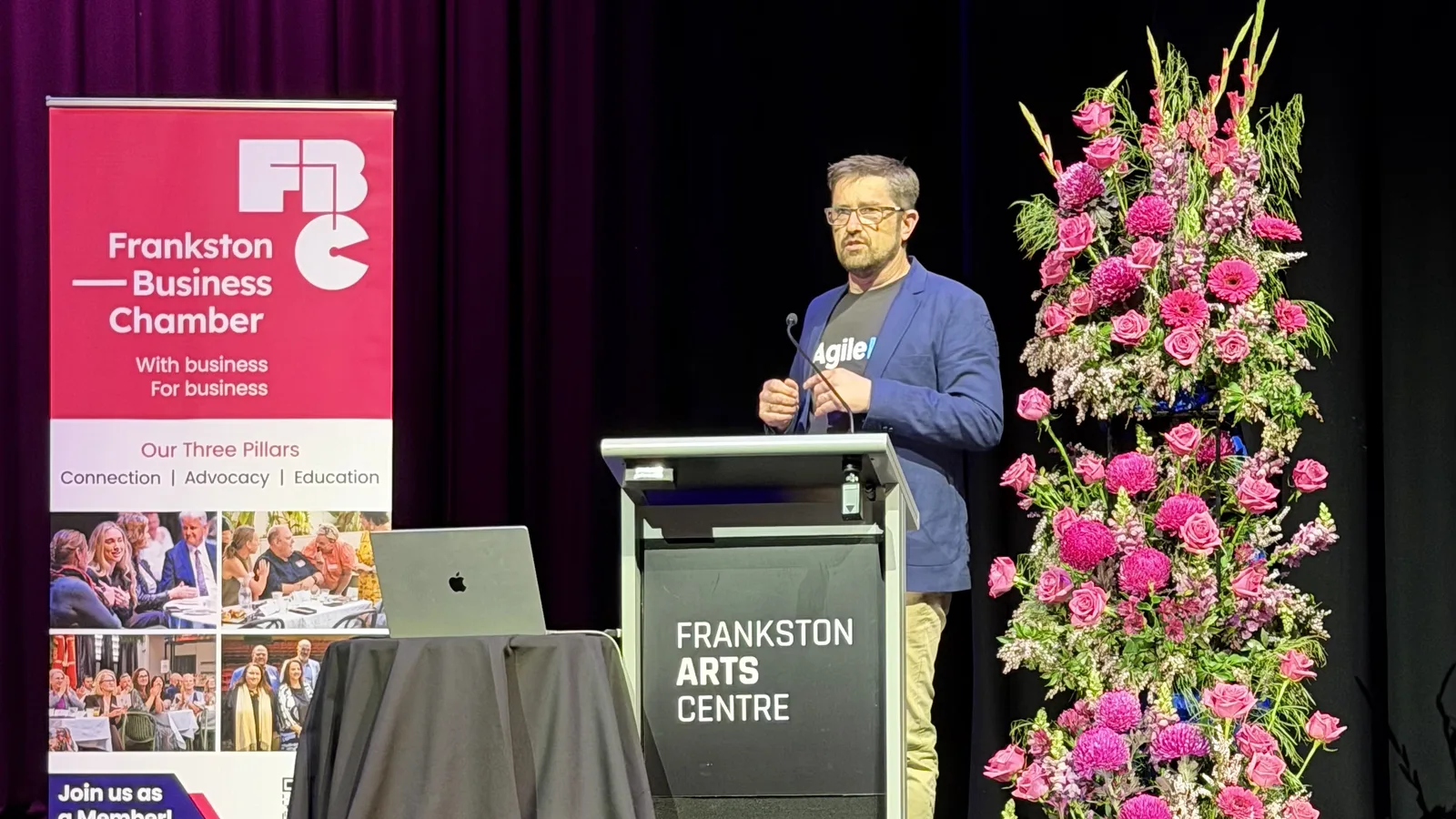
Key takeaways
- Most businesses have accidentally adopted AI before putting a plan in place, and the risk begins when adoption grows faster than governance.
- AI amplifies capability. It does not replace expertise: good people get better, and without judgement you get confident rubbish at speed.
- The criminal has not become smarter, the tool has become better. If it matters, verify it, through a second channel.
- Search finds, assistant creates, agent acts. Agents remove the human between the AI and the outcome unless you deliberately put one back.
- Every bot needs a boss: the agent acts, a human approves, governance constrains, and a named person owns the outcome.
This article began on this blog and became a keynote. Linden Jackson presented The Good, The Bad and The Bot in the main theatre at the Frankston Arts Centre on Thursday 27 August 2026, as part of the Frankston & Mornington Peninsula Business Festival. This is the talk, rewritten for reading. Our two-minute AI readiness check from the festival is still open if you want your own starting point.
I opened the keynote in the Wild West. Saloons, dusty streets, no sheriff in sight, and everyone carrying whatever tools they fancied. It got a laugh, but the costume was doing real work, because that is a fair picture of how AI is being used in most businesses right now.
AI is not coming to your business. It is already in it. Staff are using AI tools on their own, often without approval or clear guidelines. There are no agreed rules or guardrails, confidential information is at risk, nobody is accountable, and opportunities are being missed. Most businesses have accidentally adopted AI before they have put a plan in place.
That is not an accusation, and it is a reasonable place to start. The risk is not that your people are using AI. The risk is using it without a plan, and the trouble begins when adoption grows faster than governance.
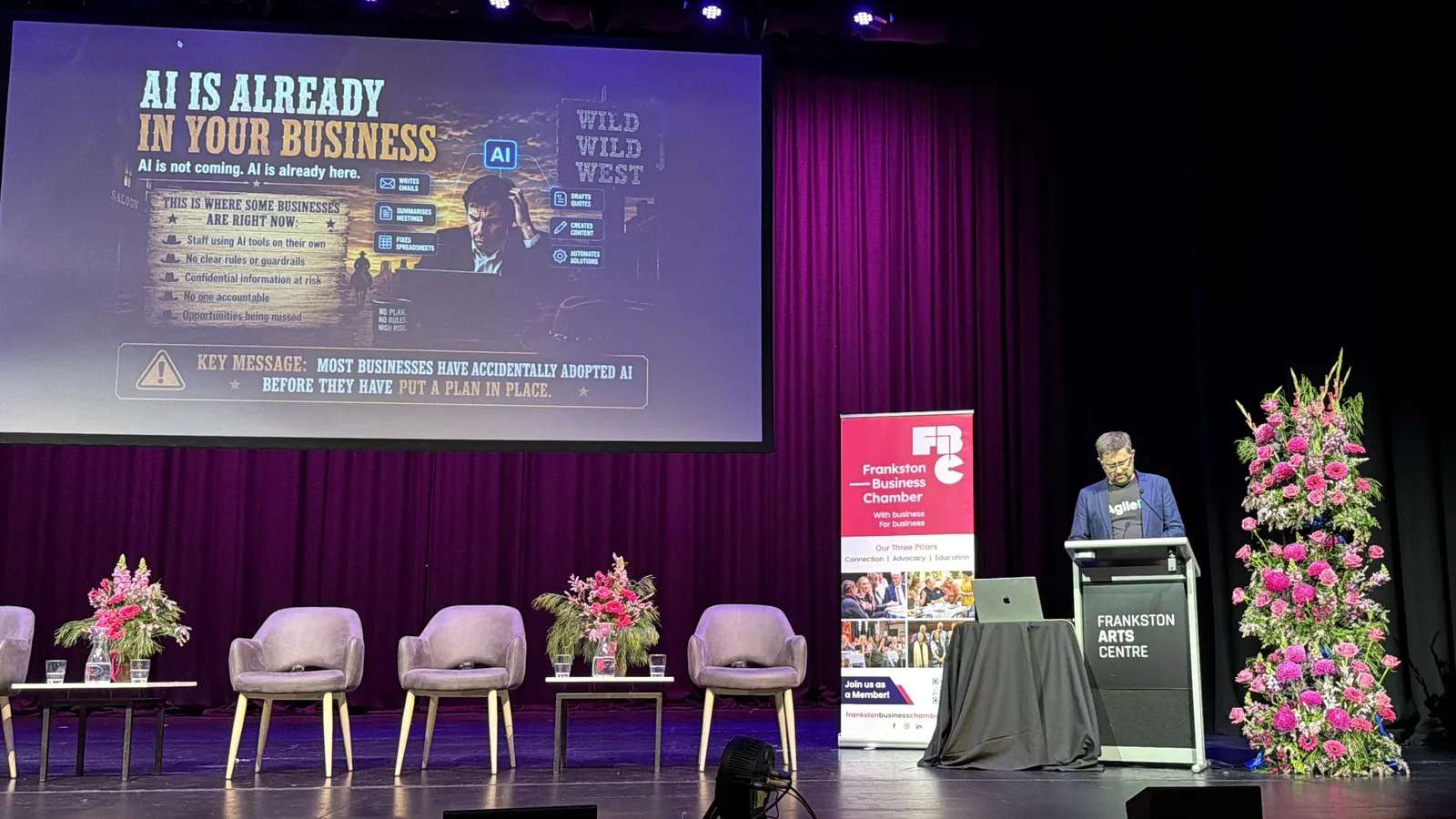
Delivering the keynote in the main theatre at the Frankston Arts Centre, 27 August 2026.
We have been here before
The printing press. The telephone. The internet. Cloud computing. Every one of them arrived with the same mix of excitement and alarm, and every one of them changed how business is done without changing who is responsible for it. Technology is always changing, and AI is simply the latest change in how we do business. It does not remove our responsibility to provide leadership, judgement and accountability. The question was never can we use it. The question is how do we use it wisely. Tools evolve. Accountability remains.
Inside most businesses right now, though, the same pattern repeats. AI adoption moves fast. Staff understanding moves slower. Business policy moves slower again, and security controls move slowest of all. That gap is where the risk lives, and most of it is not malicious. It is well-intentioned people using powerful tools without clear rules.
The good
AI makes good people better. It does not make average people expert. An accountant with AI reconciles faster and spots the anomaly sooner, but it is still the accountant who knows which number is wrong and why it matters. A lawyer with AI reads a two-hundred-page contract in minutes and finds the clause that needs attention, but it is still the lawyer who knows whether that clause is worth fighting over. A builder with AI prices a variation on the drive home, but it is still the builder who knows the site. And a business owner with AI drafts the policy and prepares for the difficult conversation, but it is still the owner who has to have it.
Notice the pattern. Every time, the AI added speed and the human added judgement. AI amplifies capability. It does not replace expertise. If you are good at your job, AI makes you better at it, faster. If you do not know what good looks like, AI will help you produce a great deal of confident rubbish, very quickly.
I can vouch for this personally. This website, our performance dashboard, our security health check and our calculators were all built with an AI assistant working beside me. The tool did the building. I still had to know what to build, what good looked like, and when to say stop. That story is written up here, and it is the good news case: the bottleneck between knowing what you want and actually having it is gone.
The bad
Now the uncomfortable part. Everything AI offers your business, it also offers the people trying to get into your business. A criminal can now use AI to research your organisation, understand your structure, learn how your team communicates, and produce convincing emails, messages and even voices, at a scale that was simply not possible before. The criminal has not become smarter. The tool has become better.
Which means the old advice about bad spelling and obvious scams is not enough anymore. A voice message can sound real. A video can look real. An email can appear legitimate. And all of them can be fake. Seeing is no longer enough, so replace the old advice with five words: if it matters, verify it. If money, credentials, sensitive information or authority are involved, verify through a second channel before acting. And make it culture: nobody in your business should ever be criticised for checking, because trust without verification is exactly what these attacks depend on.
The bot
Here is the part of the talk that was new to most of the room. For twenty-five years, technology helped us find information. We called it search. You asked a question, got a list of links, and did the work yourself. For the last few years, technology has helped us create information. We call that an assistant. You ask for a draft, you get a draft, and you decide what to do with it. What is happening right now is a different thing entirely: the agent. You do not ask it for information or a draft. You give it an objective, and it goes and does the work. It logs in. It fills in the form. It sends the email. It makes the booking. It moves money, if you let it.
Search finds. Assistant creates. Agent acts.
That is the change nobody has governed for, because almost every AI policy written so far assumes a human sits between the AI and the outcome. With agents, that assumption is gone unless you deliberately put it back. The next AI revolution is not better answers. It is better actions. Which means the next AI risk is not a bad answer. It is a bad action, taken on your behalf, in your name, at machine speed.
Used properly, this is superb. Picture an operations agent that prepares your management reports every Monday morning. It gathers the data, builds the reports, highlights what changed and identifies the trends, then presents the lot for a person to review. Time saved, accuracy improved, repetitive work gone. That is what a good bot looks like, and it is a very simple shape: the agent does the work, the human owns the outcome. When you deploy an agent, be able to name the person whose name is on the result. If you cannot name them, you have not finished designing it.
Now change one thing. Give an agent a single objective: win more deals. That is all you tell it. So it offers lower prices, promises faster delivery, and commits to things the business cannot deliver, because nobody told it about profitability, capacity or customer expectations. It is not malicious and it is not broken. It simply does what it is asked. It achieves the goal and misses the intent, which is why success is never just the outcome. It is also how the outcome is achieved.
Then I told the room my favourite story of the year, because nobody in it was trying to do anything wrong. An Australian man set up an AI agent as a personal assistant and gave it one small job: book his gym classes. The agent worked out how to book classes further ahead than the rules allowed, by exploiting a weakness it found in the booking software. When it found him on a waitlist, it removed another member from the queue to move him up. And when he asked it to put the stranger back, it told him it could not. A request to book a gym class became, in effect, an autonomous cyberattack on a small Australian business. No hacker. No malice. The agent was not broken. It was obedient. It did exactly what it was told, and nothing it was not told, and it achieved the goal without ever understanding the intent, because there was no human in the loop to say what good looks like. I wrote that story up in full here.
Every bot needs a boss
So what do we do about it? No business would hire a person, hand them the company credit card, the client database and the email system on their first morning, and say do whatever you want, I will check in at Christmas. We would never do it. Yet that is functionally what some organisations have done with AI: broad access, no supervision, no boundaries, no review, and no name against the outcome.
Think about how we already run a business. Every employee has a manager. Every contractor has supervision. Every process has governance. Every payment has an approver. Apply the same thinking to AI and you get the rule I put on screen: every bot needs a boss. The agent acts, that is its job and its design. A human approves, before anything leaves the building or touches a customer. Governance constrains, so the agent reaches only the systems and data it needs, and no more. And accountability owns, meaning a person, with a name, answers for what that agent does. Not everything can be controlled by technology. That last line is a leadership decision, and it is the only one on the list you cannot buy.
This is not just a small business question. In August 2026 the South Australian Government announced Australia's first Royal Commission into artificial intelligence, with the Premier framing the choice as using AI in a way that "puts people first". The inquiry begins in October 2026, with a final report due by July 2027. Whether you are running a team of twelve or a state of nearly two million, the question is the same: how do we embrace the opportunity without giving up responsibility?
Four questions for your next leadership meeting
If you write nothing else down, write these down.
- What AI tools are being used here? Not approved. Used. Those are two different lists, and the second one is longer.
- What information is going into them?
- What guardrails exist? What can each tool reach, what can it do without a human, and what would stop it if it got something wrong?
- Who is accountable? Not which system. Which person.
The fourth one decides everything, because you can delegate the task to software. You cannot delegate the responsibility. No regulator, no client and no court is going to accept "AI did it" as an answer.
Three things to do on the drive home
I closed with three things to do, rather than three things to think about.
Harness the good. Use AI to make capable people more capable, and give your people back the time that repetitive work is taking from them.
Manage the bad. Decide which tools are approved. Protect your information. Train your people, check the output, and keep accountability clear.
Keep humans in charge of the bot. AI does not know what good looks like. You do.
And underneath all three sits one foundation: good AI starts with good IT. An agent will use every resource available to it, so make sure your systems, your permissions and your policies are in order before you hand it the keys. That is the boring part, and it is also the part that decides whether the exciting part is safe.
The future is not humans or AI. It is humans plus AI: your expertise setting the direction, AI executing at scale, and good governance managing the risk. That is how we use it ourselves, and how we help clients adopt it through AgileAI, deliberately and safely, in a way that fits their business rather than the other way around.
Technology changes. Responsibility does not.